In a world where your most desired archetype is also one of the most expensive in the sport, you have to be prepared to take some big swings. The Toronto Maple Leafs just made a whopper, acquiring defenceman Darren Raddysh from the Tampa Bay Lightning for a 2026 fifth-round draft pick, followed by an immediate eight-year contract extension worth $68 million ($8,500,000 AAV).
Raddysh is a unique blend of age and experience, with only three full NHL seasons under his belt at 30 years old. Originally undrafted, the Toronto native played all the way to his over-age year with the Erie Otters of the OHL before singing with the Chicago Blackhawks. He played a season and a half without an NHL call-up before being traded to the New York Rangers, who then played him in Hartford for two and a half years without a call up.
The Tampa Bay Lightning signed Raddysh during the 2021 offseason and didn’t immediately find paydirt, getting just a so-so first year out of him in Syracuse, but did give him his first cup of NHL experience in 2021/22. The following season saw him make his leap, becoming a point-per-game AHL talent and earning himself 17 regular season and 6 playoff games with the big club. Raddysh became a full-timer in 2023/24 and put back-to-back seasons in the 35 point range, playing in a second-pair, secondary special teams role in his first year and a second-third pair, more powerplay-focused role in 2024/25.
While finding a useful right-handed defenceman for free was already a great get for the Lightning at this point, this season was where everything changed. With Victor Hedman missing 49 games, Ryan McDonagh missing 34, and Eric Cernak missing 21, a lot of opportunity became available to any Tampa Bay defencemen who was willing to take the reins in roles across pretty much any game situation. On the defensive end, it was J.J. Moser who stepped up. On the offensive end, it was Raddysh.
Raddysh exploded in 2025/26, handling top-pair deployment with unexpected success and anchoring Tampa Bay’s top powerplay, carrying pucks with ease and seemingly having a magic touch whenever he took a shot of his own. His 70 points ranked 7th among NHL defencemen, and his 22 goals tied Zach Werenski for the third-most from a blue liner this year. His 10 powerplay goals led the league among defencemen, all typically being heavy slapshots.
With that last sentence, a mass unfurling of ears occurs within Toronto.
Yes, in a lot of ways, Raddysh is a player built to satisfy the checklists of the median Maple Leafs fan. Right handed defenceman? Check. Local boy? Check. Bombs on the powerplay? Check, in a league that has fewer and fewer guys who can check that box. Willing to block a shot or throw a hit? Not at a league-leading level, but enough to get a check. Takes away from a division rival? Check that one too.
So is this, coming via the Lightning, the perfect storm? It’s definitely a lot to get excited about, but there’s also a fair amount of reason to feel wary.
For one, this was a really, really big pop year at an age where guys don’t usually get them. Dom Luszczyszyn wrote a great piece at The Athletic a few weeks ago trying to projected Raddysh’s fair value going into free agency, and one of the most interesting things he did was take his player and contract projection model and apply it both to Raddysh right now, and where it would’ve seen Raddysh twelve months ago. The model right now sees him as a $12.4 million player if he can keep this up, but it also sees last year’s version of him as a $4.8 million player in this year’s market. The gap between those numbers is 90% of the way to the actual AAV that Toronto has given him.
I think it’s safe to say he’s a better player than the 2024/25 version of him. While his athletic development has almost definitely peaked at his age, there is still some mental growth that comes from playing in the NHL with as little experiences as he’s had, so we can assume there was some game refinement that occurred year-over-year. There’s also a matter of those injuries presenting opportunity to him that he might not have had otherwise, both from the perspective of having the chance to learn and grow from the increased usage, and from simply showing he’s capable of being in those higher value, generally more productive situations.
At the same time, he shot 10.4% last year. That’s the fifth-highest shooting percentage for a defenceman in this decade with 200+ shots, and that’s with ten of his goals coming from beyond the offensive zone faceoff circles. Rookie sensation Matthew Schaefer had a near-identical shooting percentage this year with one extra goal, but scored nine of his in the slot. Cale Makar, who’s 30-goal 2024/25 season leads this list at 12.2%, scored about about half of his from in deep, but is generally one to finesse wrist/snap shots from the edges of that line, rather than one to bomb one timers.
He’s also a career 10.3% shooter, while Raddysh sat at 5.5% before this season, and 6.2% in the AHL. So you wonder a little about how that holds up moving forward, especially when you don’t have Nikita Kucherov feeding the primary assist on 15 of your 22 goals.
But if you’re not paying him at a rate that’s consummate with producing like this every year, maybe you don’t need him to produce all the way to the same clip every year? Maybe a powerplay unit that already has high-end shooters and poachers doesn’t need that one-T to find top corner every time, or even always be taken – just be used enough to be a threat that opposing PK units have to respect.
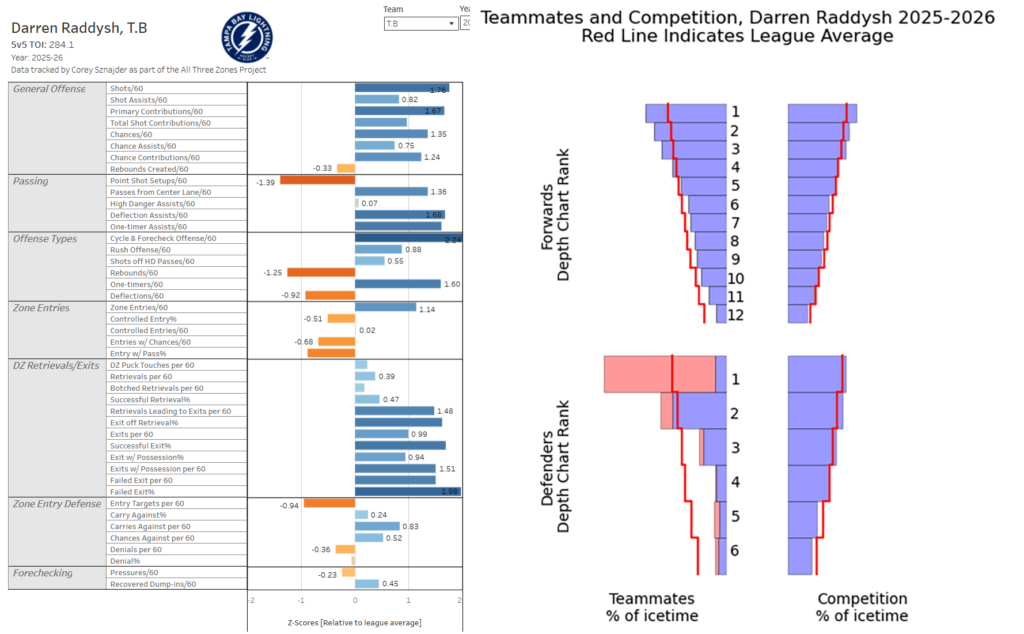
Microstats (left) via Corey Sznajder / All Three Zones / Usage (right) via Micah McCurdy / HockeyViz
Maybe they just need Raddysh to be able to chew a good chunk of minutes, move pucks forward, and push the pace of play. Given his positive impact on team shot attempts in every season he’s played in Tampa, including a year where he led the team in average ice time while proportionately playing the second-most among d-men against top competition (CTOI% vs. Elite, via PuckIQ), the first point seems attainable. His shooting, passing, and breakout underlyings this year more than pass the test for the latter two bullet points, and are a sight for sore eyes after watching the Leafs of the last couple of seasons. Combine that with acquiring Emil Andrae for the depths of the lineup earlier this week, and the team’s forecast to win zones with control feels significantly better already.
Importantly, they’re not paying Raddysh to be a point-per-game defenceman for the forseeable future, at least by average value. His new deal sits in a tie for the 21st-highest AAV among defencemen in the NHL – steep at the moment, but likely to continue to fall by quite a bit as the post-Covid cap continues to swell. To put things into easy context here, a $8.5 million cap hit this season is the equivalent of about $6.7-6.8 million during the “flat cap” era of 2019 to 2024. If you feel he’s even a premium second-pair option, you’re probably okay at this cap hit. If you feel he’s a first pair guy for the next few years, you’re laughing.
The big question mark here comes with the eight years part. One would argue that it’s the cost of doing business here, as you’d be paying a higher AAV for a shorter term. This might be more true than ever for Raddysh, as this contract is really the only huge payday he’s going to get in his NHL career. Given that he’s likely only pulled in a raw NHL salary of about $3-3.2 million total at age 30, there was no way he was ever going to take a chance on proving he could do this again before signing for the mega-mega deal. Getting something substantial now was always the play.
Tampa Bay, masters of finding new guys and already carrying Hedman, McDonaugh, Cernak and Moser, were not willing to swing for the fences, reportedly peaking at $5.75 million per year for five years. Is that a warning sign for Toronto? Maybe, or maybe it’s just Tampa being consistent in what they do, knowing they have depth and a development pipeline to find the next guy.
In general terms, that’s how I’d like Toronto to operate, and the idea of signing a player with one great season to his name until he’s 38 does worry me. I also think this was going to be Toronto’s easiest opportunity to get an offensive right-shot defenceman at a minimal asset cost for the forseeable future, and that other teams would have been willing to pony up at least as much, even if Tampa is holding to their principles.
Because he’s of such a high-value archetype, he’ll also likely be the type of player that Toronto can parachute off of if the fit begins to show signs of not being the fit they were hoping for.
Where I do have real worries is the totality of Toronto’s blueline commitments. Toronto currently has seven defencemen aged 29 or above committed for next year, with Morgan Rielly (32), Jake McCabe (32), and Chris Tanev (36, if he’s ever healthy again) committed to for the next four years, and Oliver Ekman-Larsson (34) committed to for the next two. I’d like to see them continue to push to make that group younger, faster, and more creative, and while Raddysh somehow checks all those boxes as a 30 year old that almost no one was aware of a year or two ago, the work can’t stop here, or the blue line will continue to be the most knotted-out area of the depth chart, slowing the pace of play on the ice while knotting up flexibility on the balance sheet.
Overall, I’d put my feelings on this move as “cautiously understanding”. I generally don’t like signing anyone who isn’t a superstar to significant term in their 30s. I’m generally very weary of pop years with high percentages. I generally come from a mindset of “don’t sign the breakout guy, find the next version of him”. I think that’s all true and I’m not ruling out the possiblity that this ends with some sticker regret. But at a low acquisition cost and with a percieved (and at least somewhat legitimate) need for a player of his style, I understand it.
It’s a risk, but one who should remain attractive throughout the league if the first couple of seasons are luke-warm, and one that could pay off in a big way if he’s even just able to keep up the process part of this past season with 70% of the results. I’ll also happily take the Leafs organization spending its risks on potential impact players over the previous years of spending premiums on low-ceiling additions.
Like their other moves this week, we’ll have a better idea of what Raddysh can mean to the team once we have a better idea what the full team, on and off the ice, looks like.

Leave a Reply