The Toronto Maple Leafs headed into noon on July 1st with approximately $21 million in cap space and not a lot to worry about in restricted free agency – easily their biggest war chest heading into a Free Agent Frenzy in about a decade.
Within four and half hours, that figure was – at least for the time being – back in the red. It turns out the team’s trade of Nick Robertson earlier in the morning was just the start of an overhaul of their forward group and goaltending, as the team made six signings and one trade.
We’ll get to the forward moves in a separate post, but the he biggest news here, of course, is the signing of Bobrovsky, who agreed to a three-year, $21 million deal with the team carrying a $7,000,000 AAV this afternoon.
The resume speaks for itself – two Stanley Cups, two Vezinas, a handful of international medals, 456 wins, and an all but certain future induction into the Hockey Hall of Fame. Not bad for a undrafted free agent.
Interestingly, the resume kind of forks into two eras. Vezina Bobrovsky was the one who played for the Columbus Blue Jackets, winning in his first year with the team (and third in the league) in 2012/13, and winning again in 2016/17 to show he wasn’t just a benefactor of a shortened season.
Stanley Cup Bobrovsky played for the Florida Panthers, though for a while, it felt it wouldn’t just never happen, but that it wouldn’t happen in part because of him. Bobrovsky’s seven-year, $70-million deal with the Cats signed in 2019 was one of the richest for an NHL goalie, made worse by the flat cap, and made worse by the fact that he, frankly, just wasn’t that great for much of it. Going into the 2022/23 playoffs, Bobrovsky had put a 105-54-14 record across three seasons, but paired it with a rather pedestrian 0.905 save percentage and 2.97 goals against average. He’d only posted an above-average save percentage in about 55% percent of his starts, and his goals saved above expected per hour was almost exactly league average (48th of 94 goaltenders with 1000+ unblocked attempts against).
But then he faced the Boston Bruins in the first round of the playoffs and… to be honest, he was okay? Alex Lyon actually started the first three games, and while Bobrovsky closed out the final five games, he put up a pretty unspectacular 0.891 save percentage.
In the second round, though:
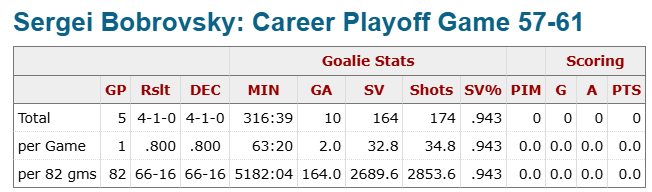
Spectacular. A sight to behold. A brick wall, allowing just 10 goals on 17.8 expected goals. He even had a 0.926 save percentage in the inner slot! Boy, would it suck to be the team that faced him… *checks notes* ah, well, nevertheless. Bobrovsky remained scorching against the Hurricanes in the Conference Finals, before giving up 21 goals in 5 games in the Stanley Cup Final.
The next year was his best regular season in Florida – the only one in which he recieved Vezina Trophy votes, finishing third – and then he did the thing in the post season. Well, the Panthers did at least – Bobrovsky outperformed the shot quality he faced, but not by a huge margin (55 GA on ~58 xG). His per-series save percentages were 0.896, 0.907, 0.921, and 0.899.
The year after that? Another ring, and 10 goals saved above expected (53 GA on ~63 xG). Like 2023, though, all of this came from going hot against the Leafs and Hurricanes (~12 GSAx in 8 games between Game 4 of Round 2 to Game 4 of Round 3). His regular season was above average, but not substantially so, and came with a 10-point dip in save percentage from the previous season.
He followed that up this year with… the worst season of his career, bar none. Bobrovsky posted a 0.877 save percentage in 52 appearances, and put up his lowest share of quality starts since his first year in Florida. Yes, the Panthers were injured and bad, but Bobrovsky’s goals saved below expected was still in the negative, albeit only slightly at -1.75 goals across 3000 minutes of puck-stopping. As well, while “it’s harder to stop pucks when Barkov and Tkachuk are out of the lineup” is a fair argument, those guys aren’t in anyone else’s lineup either.
So was Florida Bobrovsky as good as Columbus Bobrovsky, or is he largely riding the legacy of four weeks of hockey against two teams, one of which he’s no longer able to face? That’s a huge question, and when you combine it with him turning 38 years old before opening night, it was one the Panthers weren’t eager to find out the answer to on a long year deal. When Bobrovsky reportedly sought a six year, $42 million deal, the Panthers went out and got Akira Schmid and Jacob Markstrom and said they’d try their luck.
Bobrovsky went across divisional lines and ultimately took half the term at the same paycheck with the Leafs. At least, that’s how the story goes here. The more the ink dries, the more I wonder if the six-year figure was put out there in advance, to soften the blow of the actual deal. After all, Bobrovsky playing well until his Age 43 season is obviously an absurd proposal. But playing well until his Age 40 season?
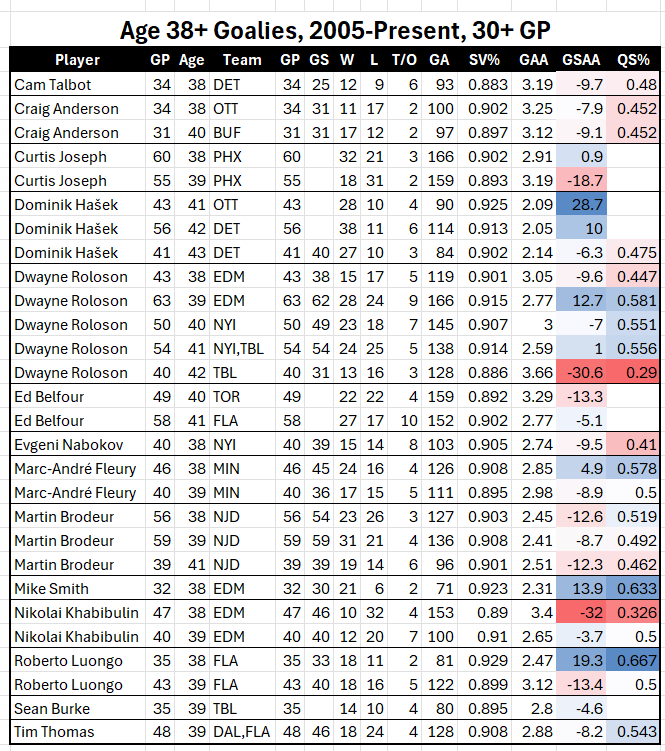
Since the beginning of the Salary Cap era, the NHL has seen just 28 seasons from goalies aged 38 or older in which they played in at least 30 games. With repeats considered, these seasons come from just 14 goalies, and just five – Craig Anderson, Dominik Hasek, Dwayne Roloson, Ed Belfour, and Martin Brodeur played a 30 game workoad into Age 40.
Despite the relatively legendary list of names here – basically everyone here has been a Vezina threat or winner at some point and a solid half of the list either is or will end up being in the Hockey Hall of Fame like Bobrovsky, it’s not a banner list of seasons. Just eight of these 28 seasons come out the other side with an above league-average save percentage, with Hasek (clearly, twice) and Roloson (barely) being the only ones to do it in an Age 40+ year.
Belfour’s name being here is particularly interesting, as he’s mentioned as a positive example of why signing a veteran goalie might work again in Toronto. Belfour bounced back from a tough final season in Dallas and had two great years in Toronto, but a poor third season was arguably the single biggest reason they missed the playoffs in 2005/06.
Another interesting name here is Roberto Luongo, who likely had some say in Florida’s decision to move on – he himself was a netminder who was put up arguably the best season on this list at Age 38, before falling off a cliff the next season and calling it quits days after turning 40.
Goaltending is hard, and it’s harder with miles and age put on the body. It’s unlikely that Bobrovsky will repeat last year’s result, which was the worst save percentage for a 50+ game goaltender in the salary cap era by a full percentage point. But to go back to a high-end number, and hold onto that standard for the next three years? That feels almost as unlikely.
Maybe your goal is spot duty and hope for the best at the right moment – think what the Hurricanes have done with Frederik Andersen in the last few years. But that seems like a lot of money to spend to do that, especially when the situation with his tandem-mate, Anthony Stolarz, is that he’s one of the league’s best goalies over the past few years when he’s healthy, and seemingly the guy you’d want to be the “closer”, rather than the guy you bring a closer in for.
Who knows, maybe this works. Maybe you’re really banking on his mentorship, that legendary talent finds a way, and that the third year might not matter. When you put it that way, it starts to feel like a goalie version of signing Patrick Marleau in 2017. That deal (which, in fairness, I advocated for) worked in Year 1, became a drag midway through Year 2, created a costly salary-dump trade before Year 3, and the mentorship of it all has become a debated subject since.
There’s just so many variables here and not a lot of positive historical precedent. I’m a pretty big believer in not significantly committing to goaltenders if you don’t think you have a consistent superstar. The Leafs already had a decent, if injury prone duo in Anthony Stolarz and Joseph Woll, and two unproven but intriguing pipeline goalies in Denis Hildeby and Artur Akhtyamov. Woll was moved a few weeks ago, which made sense, but moving Hildeby to a division rival (more the totality of that trade in my next post) to clear the way on top of that really increases the necessity for this to work.
It’s a big risk. Thankfully not as big of one as originally reported on the contract front, but one nonetheless. It’s a netminder who has had incredible peaks, but an inconsistent last decade or so of his career, signed for a year or two too many given the warning signs of a decline. It’s moving on from your plans B and C for if this doesn’t work to make space for the opportunity. It’s about a third to a quarter of their spending budget for this promised roster overhaul to get the team back from the basement to the contender class.
Don’t get me wrong, it’s cool to have to know that a player of Bobrovsky’s pedigree will now list Toronto on his resume, as we’ve seen happen with a few other greats over the course of this era. But many of those didn’t work out as hoped either, and those generally had significantly less, both in cap commitment and ability for the player to swing the results of games, at stake.
At this point, though, all we can do is watch and find out if it works out.
Leave a Reply