Every so often in the hockey world, you see something that catches your eye and gives you a moment of curiosity, even if it’s not overly groundbreaking or even something to draw a conclusion out of.
I had one of those on Saturday watching the second day of the NHL draft, which featured Rounds 2 through 7 – or about 85% of the actual drafting. Specifically, my lightbulb came from watching Braidy Wassilyn go undrafted – a statement that would seem impossible two years ago.
While I’ve spent a lot of time in minor hockey rinks over the past several years, most years haven’t seen me put a lot of priority into watching and ranking the top U16 players. With Junior A and U18 being my priorities, those games were usually more interesting to get glances at secondary or tertiary players who might have some upside on the longer end of their development. This was true of 2023/24 for me as well, and it was a “down” year in rink time for me as well, so that was even further reinforced.
With that said, I still got a bit of a fill, and the hype around Braidy that year was evident. Going in, he was seen as a threat to be the OHL’s first overall pick, thanks to his incredible raw offensive tools. Even the fact that he was on a mid-pack Markham Majors team didn’t seem to seem to take away from the hype. He ended up going fourth to the Niagara IceDogs, second among GTHL picks.
The years to follow have fascinated. Wassilyn’s 39 points as a rookie were good enough to keep him near the top of the class, even if he left you wanting more at times. The lack of progression in his draft year, sitting at 46 points in 62 games and goose eggs in a five-game playoffs, were a lot more surprising. He entered the season projected to be an early-round NHL pick, and when he was traded to the London Knights in October, it was thought to be a blessing for his chances at development. Ultimately, though, his defensive game, competitiveness, and pace didn’t grow through the year as hoped, and outside of an initial streak in his first month, he didn’t show the offensive pop needed to compensate for it. By the late spring, his public rankings peaked at mid-late round, if they had him at all. By the weekend, the league ended up at “we’ll wait and see”.
This post isn’t really about him, though. He was just the inspiration. If someone who felt that sure-fire to be a dominant OHLer and beyond heading into his U16 year could fall to “we’ll see if he ends up a pro” 24 months later, then how about the rest of the class? How good are we at even looking two years ahead with these 15-or-so year-old prospects?
With that in mind, I pulled up the first round of the 2024 OHL Priority Selection and compared it to the NHL draft board on Twitter. The three picks prior to Wassilyn, – Ethan Belchetz, Alessandro Di Iorio, and Colin Fitzgerald, all got drafted in very different positions on Friday and Saturday. Of the 21 first rounders, eight heard their names called this weekend.
After sleeping on it, charting them out in the way I did was probably the wrong way to go about it. For one, the OHL and NHL drafts use different calendar ranges for drafting players. The OHL uses straight-up calendar years – for example, this year’s Priority Selection featured minor hockey players in 2010, along with players who had been passed up previously that played in another junior league full-time (those who played U18 had the separate U18 draft to contend for). The NHL separates on September 15th instead of December 31st. This is how Auston Matthews and Alexander Ovechkin (both September 17th birthdays) ended up as 1st overall picks instead of merely high firsts the year prior.
In the case of my chart, this how Luca Blonda, Dima Zhilkin, and Kohyn Eshawkogan ended up undrafted – they’re 2027 prospects. It also feels like it would’ve been a good idea to look at all of the rounds instead of just the first, so I took another crack at it. Here are all the players who were drafted in both the 2024 OHL Priority Selection and the 2026 NHL Entry Draft:
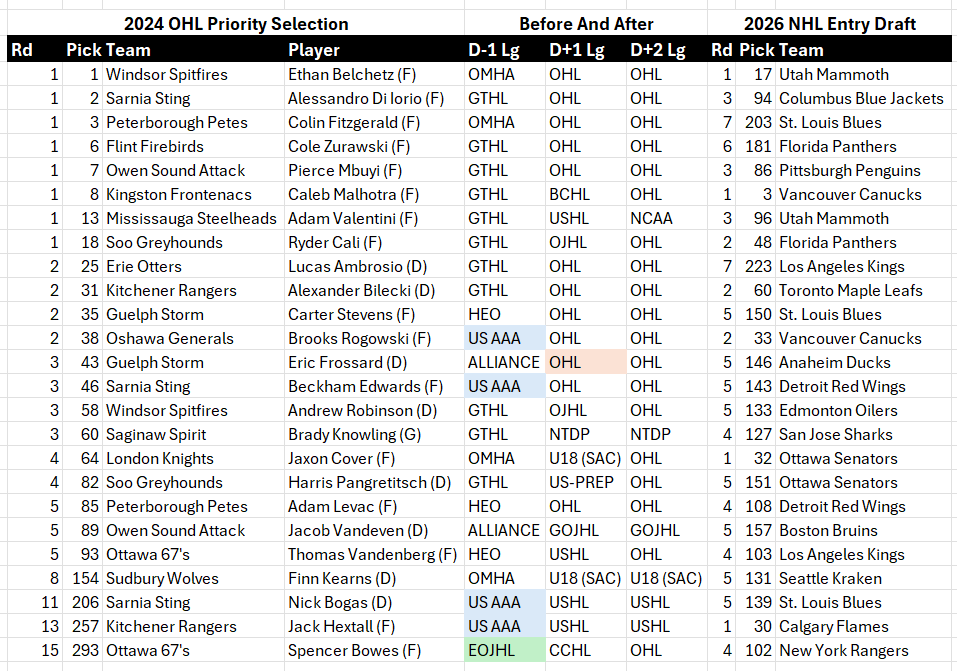
Blue highlights are players drafted out of the US. Orange highlights are players who split a substantial amount of the season between two leagues. Green highlights are over-aged players drafted out of another Canadian junior A/B league.
Generally speaking, things sort out pretty well compared to draft position here. Six of the top eight picks ultimately became NHL draft picks, though it begins to slide from there. Even the two picks beyond the top ten come with some asterisks to them – Valentini would’ve almost definitely been at least Top 5 in 2024 had he been committed to playing in the OHL, something that never materialized. Cali was another flight risk, starting his first year in Junior A before coming over once the NCAA eligibility rules loosened.
You see this even further as the draft gets longer, with a handful of American picks, some successful gambles (Rogowski, Edwards), some complete longshots that pad the numbers here (Bogas, Hextall), and some that worked out in reverse (Knowling, though he’s finally signed with Saginaw for next season). For those who hold out the dream of being a true late bloomer, you get Spencer Bowes, who was drafted as an over-aged Junior B pick in the OHL, and was days away from doing the same in the NHL this year (September 19th).
Ultimately, this means the 2024 OHL class created 25 NHL draft picks this year – a hit rate of about 8%, but also a little over 10% of the whole NHL draft. As mentioned, this is messed up a bit by the birthdate thing, and there will likely be others from this group that get drafted next year. To get an idea of how many, we can look at the 2023 OHL picks that got drafted this year:
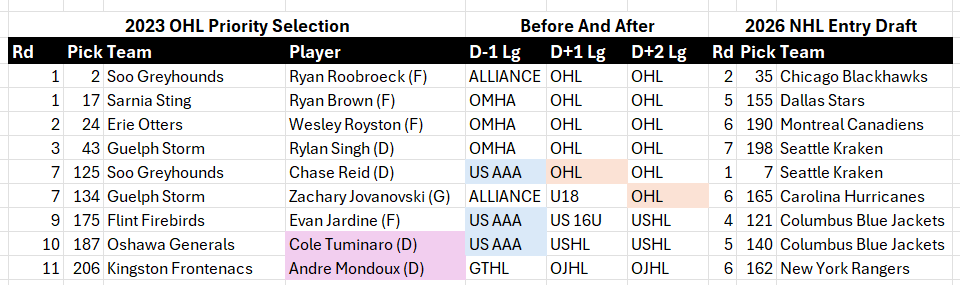
All previous highlighted colours are the same. Purple highlights are players drafted in their second year of NHL eligiblity.
This adds seven more late 2007’s to the group to make 32 draft-year picks, about 21% for the back 29% of the year. This makes intuitive sense to me, as teams will likely give tiebreakers to later birthdays when making decisions. There’s a few interesting names here – Chase Reid obviously the biggest, going seventh overall after being favoured to go as high as third. He was a pretty low OHL pick, though as an American who played US minor hockey, there’s likely some flight risk effect there. (Also, shoutout to Rylan Singh, who was a U16 AP with the Toronto Patriots when I was there in 2022/23).
There are also two over-agers in the 2023 bucket – Cole Tuminaro, who took the American pathway, and Andre Mondoux, who is a project pick as a 6’4 defensive defenceman, and someone I watched quite a bit in his U16 and Junior A years.
I’m not super sure if there’s a conclusion to take away from all of this, or even a topic to chase. Maybe there’s something to dive into about NHL projectability in the OHL draft process to find out which archetypes fare better, or a reason to dive back into past years to see if the OHL draft has been more or less successful in finding NHL draft picks in previous years. Maybe that’s something more me to dive into, or maybe one of you will find inspiration to dig deeper.
It’s also important to remember that neither draft represents an accomplished mission – getting picked doesn’t guarantee you a roster spot, and there are so many different paths and development journeys to take you to where you want to go. Certainty, that OHL draft spot doesn’t mean you should start thinking about how you spend your first NHL contract, as you’re still about ~10% of the way towards being another ~10% of the way to the show.
Either way, it was interesting to me to see who made their next step in their journey this weekend.
Leave a Reply