The Toronto Maple Leafs have officially made their first roster move of note in the John Chayka / Mats Sundin / whatever you want to call it era. The team announced late Tuesday morning that they have traded goaltender Joseph Woll and defenceman Simon Benoit to the Philadelphia Flyers for goaltender Samuel Ersson, defenceman Emil Andrae, and a third-round pick in next week’s NHL Entry Draft.
Woll, 28, originally drafted by the Maple Leafs in 2016, played pieces of the last five seasons in the NHL with Toronto, including regular duty in the last three. Across that time, he appeared in 117 regular season games, posted a 63-43-9 record, a 0.906 save percentage, and a 2.93 goals against average.
Benoit, 27, joined the Leafs as an unrestricted free agent ahead of the 2023/24 regular season and played 215 games in blue and white, scoring two goals and adding 19 assists while averaging about 17 minutes of ice time per game on the Toronto blue line.
Ersson, 26, has played the entirety of his four-year carere with the Flyers, posting a 65-50-17 record in 143 games played, to go with a 0.884 save percentage and 3.01 goals against average.
Andrae, 24, completed his third partial and second full year with the Flyers this season, and has posted 3 goals and 17 assists in 107 NHL games.
Immediate Player Analysis
The short and sweet answer is that Toronto acquires an upgrade on their blue line for a downgrade in goal.
Woll has done a more than fine job for the Leafs over his three seasons of regular play, saving approximately 34 goals above expected according to Evolving Hockey’s shot model. This ranks 27th among the 80 goaltenders who faced at least 1000 unblocked attempts in that span, and on a per-minute basis, he climbs up to 24th in that span. Injuries have been a concern for Woll over the years, having yet to play more than 42 games in a pro season, but when he plays, he generally stops pucks.
Ersson, on the other hand, is not that. He sits 80th out of 80 on that same GSAx list, with the rate basis only improving him to 76th.
Now, even with expected goals models weighing shot location and situations, it’s fair to argue that team effects could come into play here. After all, Woll put up those numbers on a team that featured Anthony Stolarz doing even better, and Ersson’s worst year of the three game when Ivan Fedotov was even worse. We’re also talking about non-elite goaltenders in their 20s, who have shown a propensity to be crapshoots. But there’s a certain point where the puck still needs to get stopped, and Ersson has been significantly worse at that than Woll, or pretty much any goalie in the league.
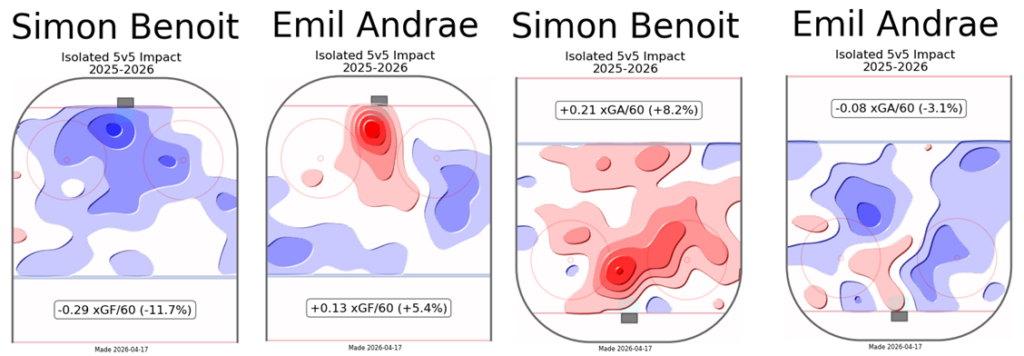
Shot impact visuals via Micah McCurdy of HockeyViz, showing a much more positive form of Ice Tilt happening in Andrae’s minutes than Benoit’s in 2025/26
On the flip side, you can make the reverse argument with the defencemen in this deal. Benoit proved himself to be one of the more likeable human beings on the Leafs roster in the past few seasons, but save for a few weeks in 2024/25 where the goals went in his favour, bad things generally happen when he’s been on the ice for Toronto. Benoit’s 38.6% share of the 5-on-5 shot attempts in 2025/26 was the worst result any 1000+ minute defender has had in Toronto since the play-by-play stat era began in 2007/08. It was the worst by any Leafs defender in the Matthews era by nearly five percent, with the second-worst being himself the year prior. His share of the expected goals was the worst in the play-by-play era as well at 40.3%, with the second worst also being his previous season.
While Benoit looked the part of the “old school” type defender that many still yearn for today, he struggled mightily to move the puck beween zones with possessions and contribute to offensive plays when the team did advance upward, a problem that has plagued the Leafs depth chart for years and is made especially obvious by players like himself. While simple defenders like him can be valuable in certain spot situations, you generally want more in their toolbox to work with beyond dumps and blocks, and if you have a coach who believes in following assignments more than being able to invent plays, it leads to players of his ilk getting more minutes than the should. Moving on from the player is the easiest way to avoid that conversation down the line.
It helps when the player they get back seems to be a more than a bit more capable. Philadelphia has generally ranged from breaking even to coming out slightly ahead with Andrae on the ice, and when you look at the micro-components of his game, he’s shown himself to be rather good at escaping his zone and setting up plays in the slot once he gets into the offensive zone. I’m a little more cautious than most in declaring him a big-time breakout candidate, as he’s doing this a under relatively light workload with generous share of shifts beginning in the offensive zone, but even a “sheltered minute star” who can escape the zone would be an improvement on what Toronto has right now. The biggest fear that you’ll probably hear is that he’s an undersized (5’9) left-handed defenceman, which generally carries little weight among experts, but the Leafs didn’t exactly fare well with the biggest and brawniest team in the league this year, so looking to anyone who can move them north isn’t a bad idea.
Roster & Cap Implications
Important in the context of this deal is the flexibility it gives Toronto moving forward. Notably, they shave Woll’s contract off the books, saving them $3.67 million per season over the next two years. Benoit saves them another $1.35 million, meaning this is about $5 million that was committed to players next season that is no longer the team’s issue.
Both Andrae and Ersson are restricted free agents, though neither are likely going to be seeking big paydays. Andrae’s usage likely keeps him under the $2 million range, especially if the team goes shorter-term. Ersson has a required qualifying offer of $1.6 million to retain his rights, and given his performance in previous seasons and the option of promoting either of Artur Akthyamov or Denis Hildeby from the AHL Marlies, I wouldn’t be shocked if Toronto chooses to simply relinquish his rights, taking him on today just to balance the contracts. Alternatively, if the market is soft, it’s possible that Ersson sees value in being in the organization and takes an extension below his QO, but I don’t immediately see him accepting the high risk of a lesser role without payment to match.
Assuming we’re looking at a combined $2.75-3 million between an Andrae extension and either Ersson taking below his QO and/or the Leafs promoting one of the Marlies instead, this deal saves them about $2,000,000 to $2.25 million – possibly more if they only go 1 or 2 years with Andrae. According to Puckpedia, this currently sits them at about $27.3 million in cap flexiblity going into July 1st.
I am curious about where Nick Robertson, Matias Maccielli, and Troy Stecher currently stand, the latter especially given the similar profile of today’s acqusition, but they’re the only players close to being able to making a dent in that balance sheet. With that in mind, Toronto has some room to play around with in free agency and the trade market.
Adding another draft pick after the past few years of depletion certainly helps as well. The third rounder acquired from Philadelphia sits at 85th overall – a general area of the draft where Toronto hasn’t drafted and developed an impactful player in this century, but there’s no time like the present to change it.
Overall First Impression
On the surface, this feels like a bit of an oddball move, made even more emotional by trading two fan favourites for a relatively unknown talent and a player we’re debating the merits of even holding onto.
When you consider all factors though, it makes some sense. It’s was in Toronto’s interest to move on from one or both of Stolarz and Woll this summer, given their age, contracts, and neither’s ability to stay healthy and sharp enough to hold onto a true starter’s workload – especially with two seemingly NHL-ready netminders waiting in the wings. It’s also very important for them to make their blue line smarter with the puck and more mobile. They used the former concern to address the latter problem, and while it’s a relatively unsexy swap, the goaltender market usually doesn’t get you blue chip returns.
Gaining some cap flexiblity and a draft pick is a welcome bonus. This move won’t make true sense without a bigger picture involved, and doesn’t provide much to truly get excited about but it does a lot of little things, so I have time for it.
Leave a Reply